
Culture & history · An illustrated essay
The history of matcha.A bowl at the meeting point of faith, power and craft.
An emperor’s journey. A shogun’s morning after. A ruler’s golden room. The history of matcha is richer—and less tidy—than a single story about Zen.
Who invented matcha?
No single inventor is identified by the sources used in this essay. Omotesenke describes Eisai bringing the Song Chinese practice of drinking stirred powdered tea to Japan in the late twelfth century. That is an important episode in matcha’s history, rather than proof that he invented modern matcha. [2]
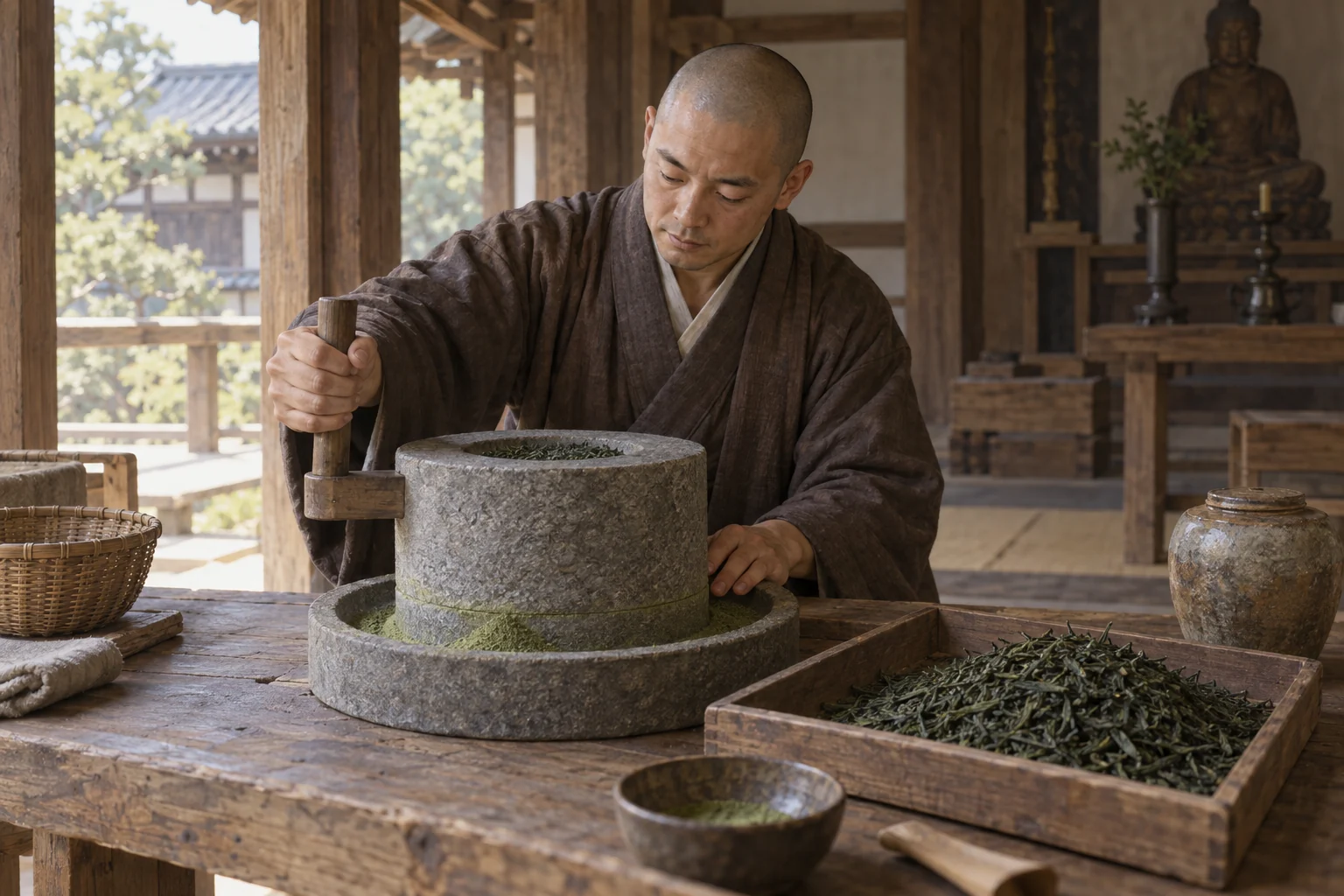
Modern matcha is made by milling tencha—leaf dried without rolling. This manufacturing distinction matters when tracing early powdered tea to the product sold today. [13]
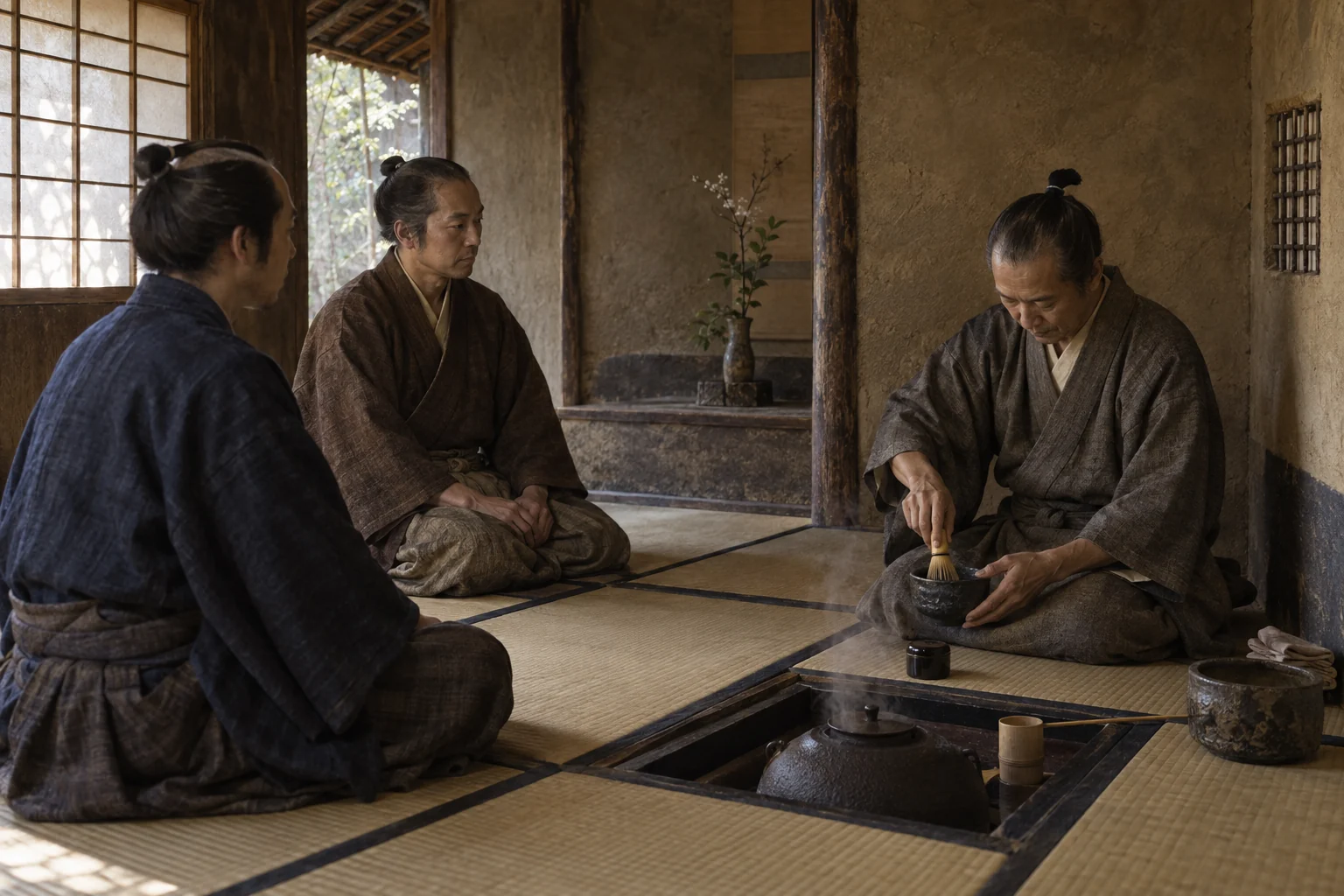
Today, matcha can arrive as a bowl of whisked tea or a drink in a café. Looking backward reveals a succession of changes: how a leaf was grown, how a powder was prepared, who could host a gathering and what a treasured object could mean.
This essay follows those changes through recorded episodes and remembered stories. It distinguishes early powdered tea from the later cultivation and processing of modern matcha, and separates documented events from teaching traditions.
01815 · Before the familiar origin story
An emperor receives a bowl of tea
In 815, Emperor Saga was travelling near Lake Biwa when the monk Eichū served him tea. The episode appears in the Nihon Kōki, an official chronicle, and is a useful place to begin precisely because it is not a story about matcha as we know it today.
Tea had reached Japan through its connections with Tang China, including religious travellers and diplomatic missions. It belonged to a world of courtly exchange and Buddhist practice well before the monk Eisai became its best-known advocate.
The distinction matters. The earliest clear written record of tea drinking is not a birth certificate for modern matcha. A beverage can arrive centuries before the cultivation, processing and social rituals that later give it a familiar identity. Eisai’s importance lies in a later renewal of that story, rather than in introducing every form of Japanese tea.[1]
02Late 12th century–1214 · Tea as medicine
Eisai, a shogun and the morning after
The monk Eisai returned from Song China with knowledge of powdered tea and became an influential advocate for drinking it. In the early thirteenth century he wrote Kissa Yōjōki, a work concerned with tea and the preservation of health. The text belongs to the medical and religious assumptions of its own time.
A memorable episode places tea at the centre of political life. The Azuma Kagami records that in 1214, the shogun Minamoto no Sanetomo was unwell after drinking alcohol. Eisai presented tea and a book praising its virtues; the book is generally identified with Kissa Yōjōki.
The scene is revealing: a monk could offer a ruler a remedy, a text and an argument for a new habit in one encounter. It does not establish a scientifically demonstrated hangover cure. Nor should it make Eisai the lone inventor of powdered tea. A Cultural Affairs Agency research report places returning monks alongside wider movement through trade and contact with China.[2][3]
03Medieval roots · A living temple tradition
A tea gathering before the intimate tea room
At Kenninji in Kyoto, the Yotsugashira tea gathering offers a striking alternative to the familiar image of a host and a few guests in a tiny room. The temple describes a ritual in which guests hold tenmoku bowls on stands while attendants provide hot water and whisk the tea.
The occasion commemorates Eisai, and its ordered movements make visible the connection between tea, community and religious observance. Tea is served within a larger ceremonial arrangement; the individual bowl is part of a collective event.
A living tradition should not be treated as an unchanged photograph of the thirteenth century. Its value here is different: it reminds us that powdered tea has more than one social shape. Before following the story into merchant tea rooms, it is worth pausing over this older institutional world, in which drinking tea could belong to a temple’s calendar and discipline.[4]
0413th–14th centuries · Stories and spectacle
The cowherd who refused tea—and the warriors who competed for it
In the Shasekishū, a collection of Buddhist tales compiled in 1283, a cowherd asks a monk for tea. The monk explains its virtues, including staying awake, aiding digestion and restraining sexual desire. Hearing the last claim, the cowherd loses interest and runs away. This is a pointed teaching story, not a verified interview with an identifiable farmer.
A very different taste for tea appears in accounts of extravagant warrior gatherings. Omotesenke’s history cites the Taiheiki’s description of Sasaki Dōyō and competitive tea drinking, or tōcha. Chinese treasures, prizes and displays of discernment belonged to this setting.
Taken together, these narratives unsettle the idea that Japanese tea has always meant quiet restraint. Tea could be the subject of a joke about religious discipline or a stage for conspicuous expenditure. Its later association with simplicity emerged in conversation with—and sometimes against—such pleasures.[5]
0514th–15th centuries · The value of a place name
How Uji moved from the margins to a prized tea origin
Tradition connects Eisai’s seeds with Myōe and then with tea planting in Uji. Uji City distinguishes that tradition from the documentary record: securely attested local cultivation appears in fourteenth-century sources.
The change in reputation was not immediate. Tea from Toganoo initially held the leading position, while Uji was counted among other origins. By the fifteenth century, Uji tea had gained a high reputation and circulated as a valued gift among aristocrats and religious communities.
This is more than a story of a region discovering that it had good soil. A place name acquired meaning through cultivation, elite preference and the exchange of gifts. A bowl could carry information about where its leaves came from and the relationships through which it reached its recipient. The authority of Uji was built over time; it should not be projected unchanged back to Eisai’s lifetime.[6]
06Medieval Kyoto · Beyond rulers and monasteries
The ordinary cup hiding behind the famous tea bowl
Histories of tea often move from one celebrated master to another. Kyoto National Museum’s exhibition on chanoyu deliberately widened that view, bringing in the tea enjoyed by ordinary people as well as the prestigious objects preserved by elites.
One example is ippuku issen: tea offered for a small payment around temple entrances. The setting is important. A person did not need to own a celebrated Chinese vessel or receive a warrior’s invitation to encounter a cup of tea.
The museum’s broader account also places powdered tea in Japan before the usual simplified Eisai origin story. It follows a long development through religious sites, towns and changing forms of hospitality. Reading these ordinary settings alongside the famous anecdotes changes the scale of the history. Tea was sustained by repeated preparation and exchange, not only by the decisions of patrons whose names survived.[7]
0715th–16th centuries · A different kind of distinction
Jukō, Jōō and the deliberate art of simplicity
Murata Jukō, Takeno Jōō and Sen no Rikyū are central figures in the development of wabi tea. Their importance is not that they discovered a way to drink without possessions. Rather, they changed the kinds of objects, spaces and attention through which a gathering could become meaningful.
Jōō was a wealthy merchant in Sakai, a commercial city deeply involved in cultural exchange. His study of linked verse helps explain why poetic sensibility belongs in this history beside kettles and tea bowls. Simplicity was cultivated by people with access to sophisticated artistic and commercial worlds.
Rikyū, who studied with Jōō, carried this approach further. Modest materials, restrained rooms and carefully chosen utensils could direct attention toward the meeting itself. The apparent plainness was deliberate. Wabi should therefore not be reduced to a rustic decorating style, or to the assumption that inexpensive objects automatically express deeper feeling.[8]
081568 onward · Tea and political authority
Nobunaga turned the tea gathering into a privilege
When Oda Nobunaga entered Kyoto in 1568, the pursuit of political power also involved the pursuit of famous tea utensils. Omotesenke describes his collecting of celebrated objects, known as meibutsu-gari, and his incorporation of leading Sakai tea masters into his service.
Possessing a renowned utensil did more than furnish a room. Its history and reputation could make it a token of authority. Nobunaga also restricted the right to conduct tea gatherings among his retainers, making that activity a privilege bestowed within his political order.
The resulting scene is far from an entirely private retreat from public life. A warrior’s permission to host tea could signal his standing with the ruler. The bowl, the invitation and the people gathered around it were part of the same network of power. This helps explain why tea masters mattered to military leaders—and why the tea room could never be wholly insulated from politics.[9]
091586 · Gold and a two-mat room
Hideyoshi’s golden tea room was only half the story
Toyotomi Hideyoshi’s portable golden tea room is an unforgettable image of tea and display. Urasenke’s account records that he took it to the imperial palace in 1586. Tea could participate in a spectacular statement of wealth and status.
But the same account also describes his small, two-mat Yamazato tea room at Osaka Castle. Hideyoshi’s taste cannot be compressed into gold alone. He could appreciate an intimate setting as well as a dazzling one.
Urasenke notes that Rikyū’s feelings about the golden room are not preserved in surviving records. The two rooms make a compelling contrast; they do not prove a quarrel.[10]
101587 · A public invitation with a powerful host
The great tea gathering at Kitano
In 1587, Hideyoshi staged the great tea gathering at Kitano in Kyoto. The shrine’s account describes notices inviting tea enthusiasts without making wealth or social rank a condition, and names Rikyū, Tsuda Sōgyū and Imai Sōkyū among the leading participants.
The scale matters. The shrine’s historical newsletter reports roughly eight hundred tea settings, referring to contemporary diary evidence. This figure should be read as a historical report, rather than as a modern attendance audit. Even so, the gathering’s ambition was unmistakable: tea was being made visible across a large public setting.
The invitation’s broad language and the ruler’s commanding presence belong together. The event was both an opening of participation and a demonstration of who could convene such a spectacle. Kitano makes the relationship between hospitality and power unusually tangible. A welcome can be sincere while also carrying a political message.[11]
1116th century onward · The garden changes the bowl
The quiet revolution above the tea bushes
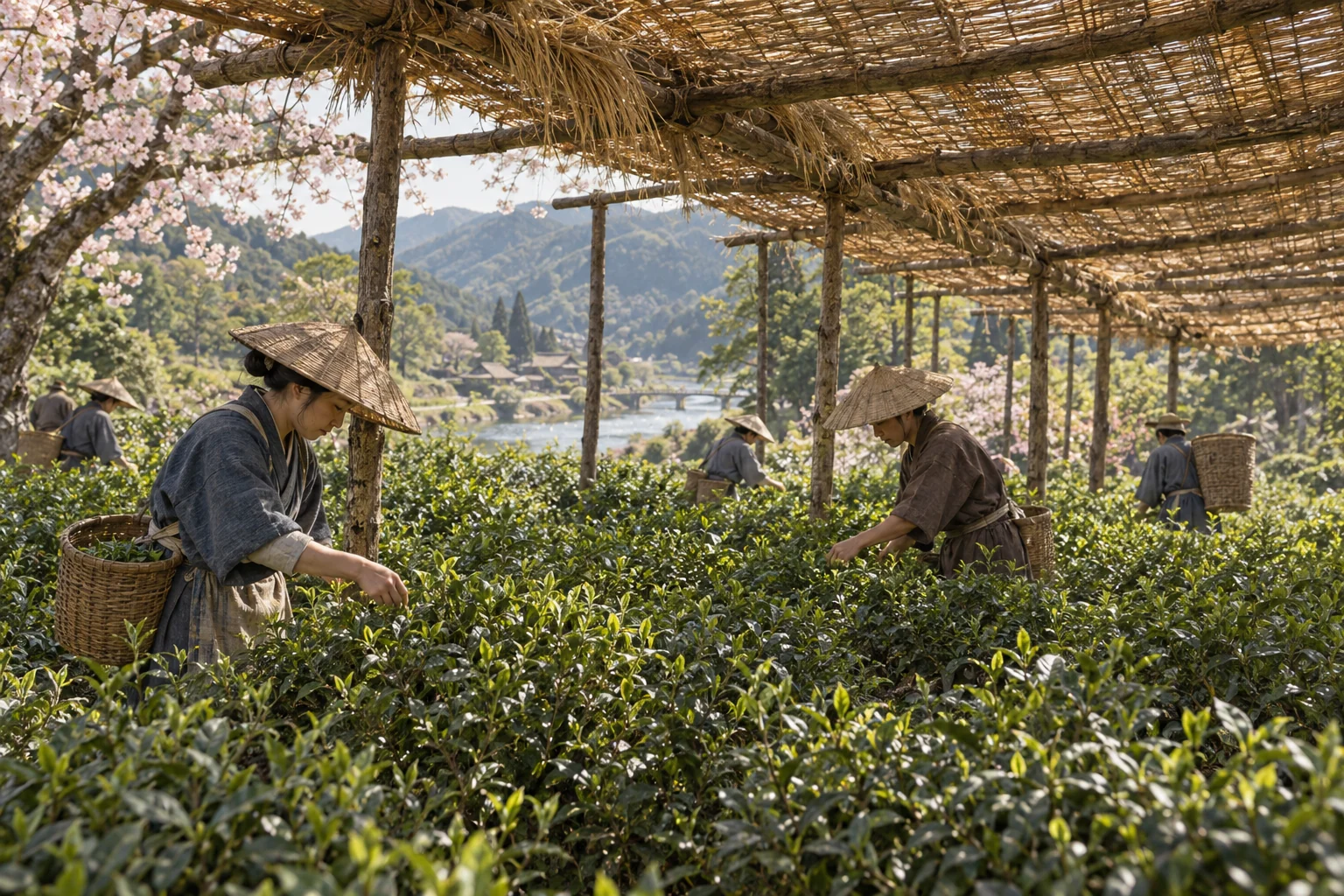
While patrons and masters were changing the tea gathering, growers were changing the leaf. Kyoto’s tea cultural landscape account places the development of covered cultivation in Uji in the sixteenth century. Reeds and straw were used above the bushes to reduce sunlight before harvest.
This matters because the story of matcha cannot be told through grinding alone. Shading became part of the cultivation associated with its green colour and savoury character. The cup’s qualities depended on work in the garden as well as work at the mill.
Processing supplies another distinction. Omotesenke describes leaves for matcha being dried without the rolling used for sencha, with the leaf material separated from stalks before milling. The intermediate tea is tencha. Modern matcha is therefore not simply a generic name for any green tea that has been pulverized. Cultivation and processing form a chain; reducing the history to the invention of a powder misses that chain.[12][13]
121591 · The limit of a tea master’s authority
Rikyū’s death—and the explanation history cannot supply
Rikyū’s authority reached deep into the cultural world of Hideyoshi’s rule. In 1585, his participation in tea at the imperial court was associated with the lay Buddhist title by which he became known. His small tea spaces, bamboo implements and work with Raku bowls helped define a lasting approach to hospitality.
In 1591, Hideyoshi ordered him to die by ritual suicide. The relationship that had made the tea master powerful did not protect him from the ruler. This is the hard political edge of the history, and it should not be softened into a story about aesthetic taste alone.
The reason for the order remains uncertain. Urasenke’s account explicitly preserves that uncertainty. It is more responsible to leave the cause open than to choose a dramatic explanation and present it as settled. After Rikyū’s death, the family tradition continued; later generations developed the three Sen houses.[14]
13Late 16th–early 17th centuries · Objects with character
A cracked water jar, a shaped bowl and the value of irregularity
The Metropolitan Museum’s exhibition on Oribe describes an Iga water jar called Burst Pouch, admired despite its cracks and associated with Furuta Oribe’s taste. An apparent flaw could become part of an object’s distinction, rather than something to disguise.
Oribe, a disciple of Rikyū, became influential in a world of inventive ceramic forms and striking decoration. It is safer to speak of ceramics associated with his taste than to imagine that he personally designed or supervised every vessel bearing the style’s name.
Raku offers a different lesson in making. The Met’s account describes bowls shaped by hand rather than on a potter’s wheel, with comparatively light forms suited to being held. Neither irregularity nor simplicity meant an absence of skill.
The point is not that all cracks are beautiful or all uneven bowls are historical masterpieces. A tea object acquired significance within a particular practice of looking, holding, remembering and choosing. Its value was relational, not a universal rule about surface appearance.[15][16]
1417th–19th centuries · Several tea histories at once
Uji’s tea jars travelled, while loose-leaf tea found its own path
During the Edo period, Uji’s tea merchants supplied privileged customers, including the shogunate and regional lords. Uji City’s account describes the official movement of tea jars toward Edo. Tea was carried through an ordered system of production, supply and status, not simply whisked in an isolated room.
Meanwhile, the history of Japanese green tea was branching. Nagatani Sōen’s eighteenth-century work in Ujitawara developed the steaming and rolling method associated with sencha. Later, gyokuro combined shading with a rolled-leaf approach.
These developments help separate two ideas that are often confused: the history of matcha and the history of all Japanese tea. A leaf could be rolled for infusion instead of prepared as tencha for milling. Shared regional knowledge supported different beverages. Matcha did not disappear when sencha developed, and sencha was not just matcha waiting to be ground. Their coexistence is part of the richness of the tea landscape.[6][17]
15From 1868 · Reinvention rather than a frozen tradition
Tea at a table, tea in a classroom, tea at a new scale
The political changes of the Meiji period disrupted the old patronage of lords and samurai. Omotesenke’s account describes tea finding new roles in education and the development of ryūrei, preparation using a table and chairs. The practice could change its physical arrangements without giving up its concern for a gathering.
School education was another route into modern life. Atomi Kakei’s school, established in 1875, incorporated tea. This was a specific educational development, not proof that access had suddenly become universal.
Production changed too. Aiya’s account of Nishio places full-scale tea cultivation there from about 1872, a shift toward tencha in the 1920s, and the introduction of a Mikawa tencha processing machine in 1930. These are a producer’s account of its regional history, not a claim that one company invented matcha.
The contemporary bowl carries these overlapping histories: agricultural technique, religious practice, commercial exchange, political patronage and repeated reinvention. Its longevity is better understood through those changes than through the image of a single, unaltered ancient ritual.[18][19]
16Tradition and interpretation · Read the anecdotes carefully
What Rikyū’s teaching stories can—and cannot—tell us
Urasenke recounts a teaching story about Rikyū’s seven rules. When someone finds the advice obvious, the master replies, in effect, that he would learn from anyone able to carry it out consistently. The lesson is about attention: prepare the tea and fire well, respond to the season, arrange flowers naturally, be ready, anticipate rain and consider the guests.
Another tradition preserved by Urasenke says that Rikyū, offered a robe by Hideyoshi, asked instead for a garden stone. The stone is remembered in the account of Konnichian. It is a story about choosing what a setting needs over accepting the expected gift.
These anecdotes illuminate the values through which later communities remembered Rikyū. They are not verbatim recordings of sixteenth-century conversations. Read as teaching traditions, they retain their interest without having to bear more historical certainty than the evidence allows.[10][20]
A few distinctions to keep
Words behind the bowl
- Tencha / matcha
- Tencha is the unrolled leaf material prepared for milling; matcha is the resulting powdered tea. It is distinct from simply grinding rolled sencha. [13]
- Tōcha
- Competitive tea drinking: a setting for discernment, prizes and display in the medieval accounts discussed above. [5]
- Chanoyu / chadō
- Terms for the practice of tea and the way of tea. The preparation belongs to a wider culture of hospitality, objects and arts. [16]
- Wabi
- An approach to restrained, deliberately chosen surroundings and objects; a historical sensibility rather than a promise that anything rustic is authentic. [8]
From the history to your cup
Choose the preparation you want to explore.
The history does not make one format right for everyone. Compare matcha packages for whisking or a latte, or read how matcha differs from other green tea powders.
Research & credits
Sources, uncertainties and illustrations
Sources were consulted on October 7, 2026. Historical dates are given by year; dates from Japanese chronicles have not been silently converted into Gregorian month-and-day dates. Institutional histories, museum scholarship, chronicles quoted by those institutions, living rituals and teaching traditions have different evidential weight.
- Omotesenke. Tea’s arrival in Japan and the Nihon Kōki entry
- Omotesenke. Eisai, medicinal tea and the Sanetomo episode
- Agency for Cultural Affairs. Research report on tea culture (Japanese PDF)
- Kenninji. Yotsugashira tea gathering
- Omotesenke. Tea’s spread, Shasekishū and tōcha
- Uji City. The documentary history and development of Uji tea
- Kyoto National Museum. Tea in Kyoto: exhibition on chanoyu, 2022
- Omotesenke. The development of wabi tea
- Omotesenke. Warrior tea: Nobunaga and Hideyoshi
- Urasenke. Chado: the golden room and Rikyū’s seven rules
- Kitano Tenmangu. Historical newsletter: the great Kitano gathering (Japanese PDF)
- Kyoto tea cultural landscape initiative. Covered cultivation and the development of tea culture
- Omotesenke. How matcha and other tea are made
- Urasenke. Rikyū, his death and the continuation of the Sen tradition
- The Metropolitan Museum of Art. Turning Point: Oribe and the Arts of Sixteenth-Century Japan
- The Metropolitan Museum of Art. The Japanese Tea Ceremony: ceramics and practice
- Kyoto tea cultural landscape initiative. The development of Uji tea and sencha
- Omotesenke. Tea from the Meiji period onward
- Aiya. The producer’s history of tea and Nishio matcha
- Urasenke. Konnichian and the remembered garden stone
The three commissioned editorial illustrations are interpretive historical scenes. They show no authenticated portrait, original historical photograph, exact documented room or product offered for sale. Their captions identify the setting and the limits of the reconstruction.